


From the Marathon Podium to City Run Victory
In spring 2024, you began structured performance training, and just a few months later you were already on the podium at the Swiss City Marathon Lucerne. What was the defining moment when you realised: Now I want to take this seriously – and how do you explain such rapid progress?
Winning the Swiss City Marathon Lucerne was certainly an important milestone. Even so, for a long time afterwards I wasn’t sure whether I wanted to pursue this path consistently or simply enjoy the moment and leave it at that. I’m naturally very competitive and ambitious, and I apparently also have good genetic predispositions. Since I’m still right at the beginning, progress is currently more noticeable and comes more quickly, which partly explains this rapid development.
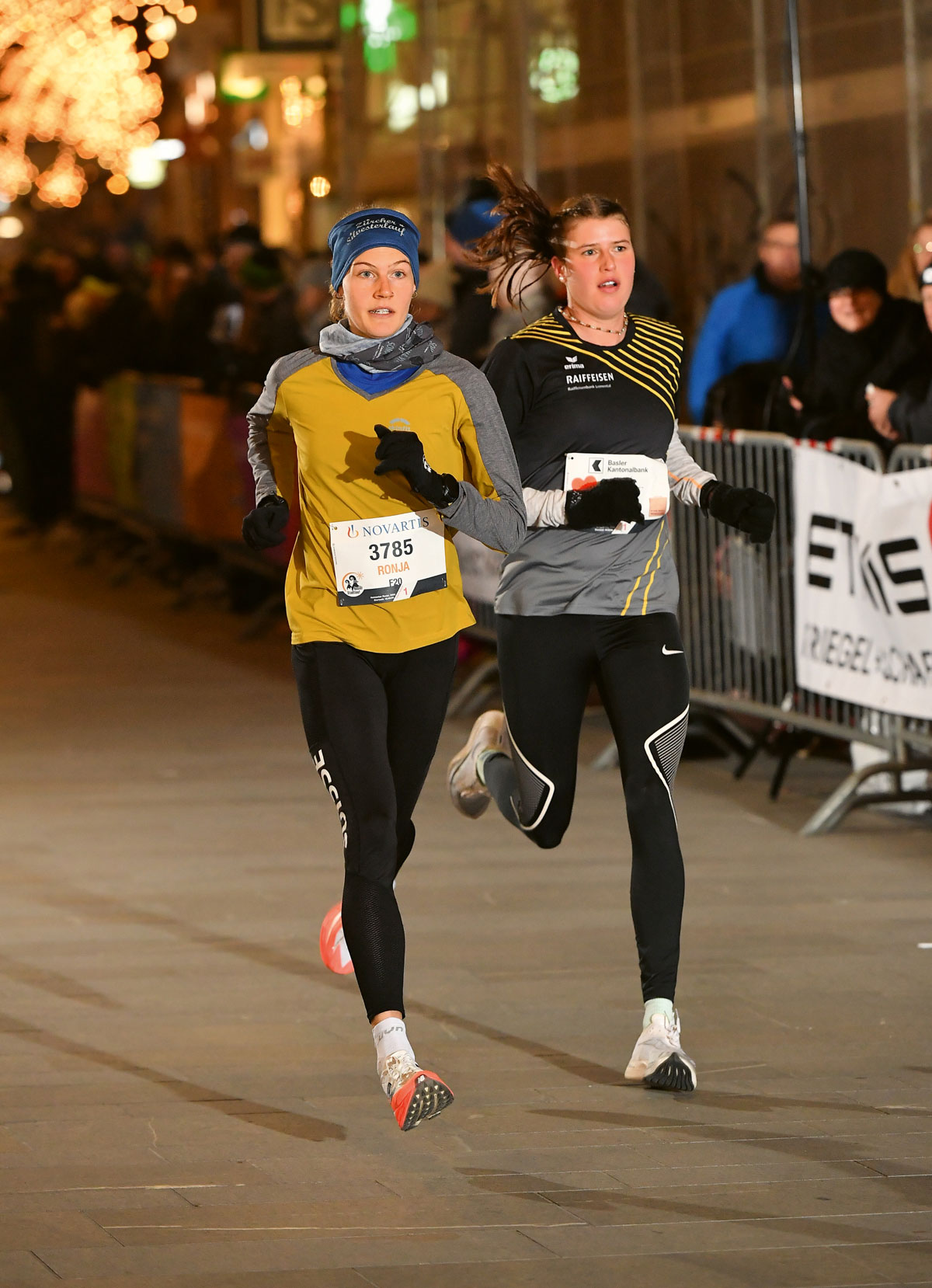
Ronja Hofstetter (left), overall winner of the Basler Stadtlauf, with Shirley Lang from LC Therwil on Freie Strasse.
At first, you trained with the support of AI, before later working with a human coach. What did this unusual start teach you about training, intuition and self-confidence – and which elements from both worlds are still part of your approach today?
I’ve never been someone who enjoys training strictly according to another person’s instructions. That’s why AI was the perfect “coach” for me at the beginning. It allows you to work very flexibly, to challenge yourself, but also to push yourself too far, because AI is usually on your side.
That phase showed me that I know my body very well, that I can challenge it in a targeted way and, at the same time, that I’m sensible enough not to overload it. That was enormously valuable for my self-confidence. To this day, I rely heavily on how my body feels and try to train with my body rather than rigidly following conventional training principles.
Although you are a classic marathon runner, you deliberately chose to compete in the 5.5-kilometre Basler Stadtlauf. What appealed to you about this format, how did you experience the atmosphere along the course, and what did you particularly enjoy about the event?
Since last year, I would describe myself more as a long-distance runner. With my long-term goals in mind, I’m currently focusing deliberately on shorter distances between 10 and 21 kilometres.
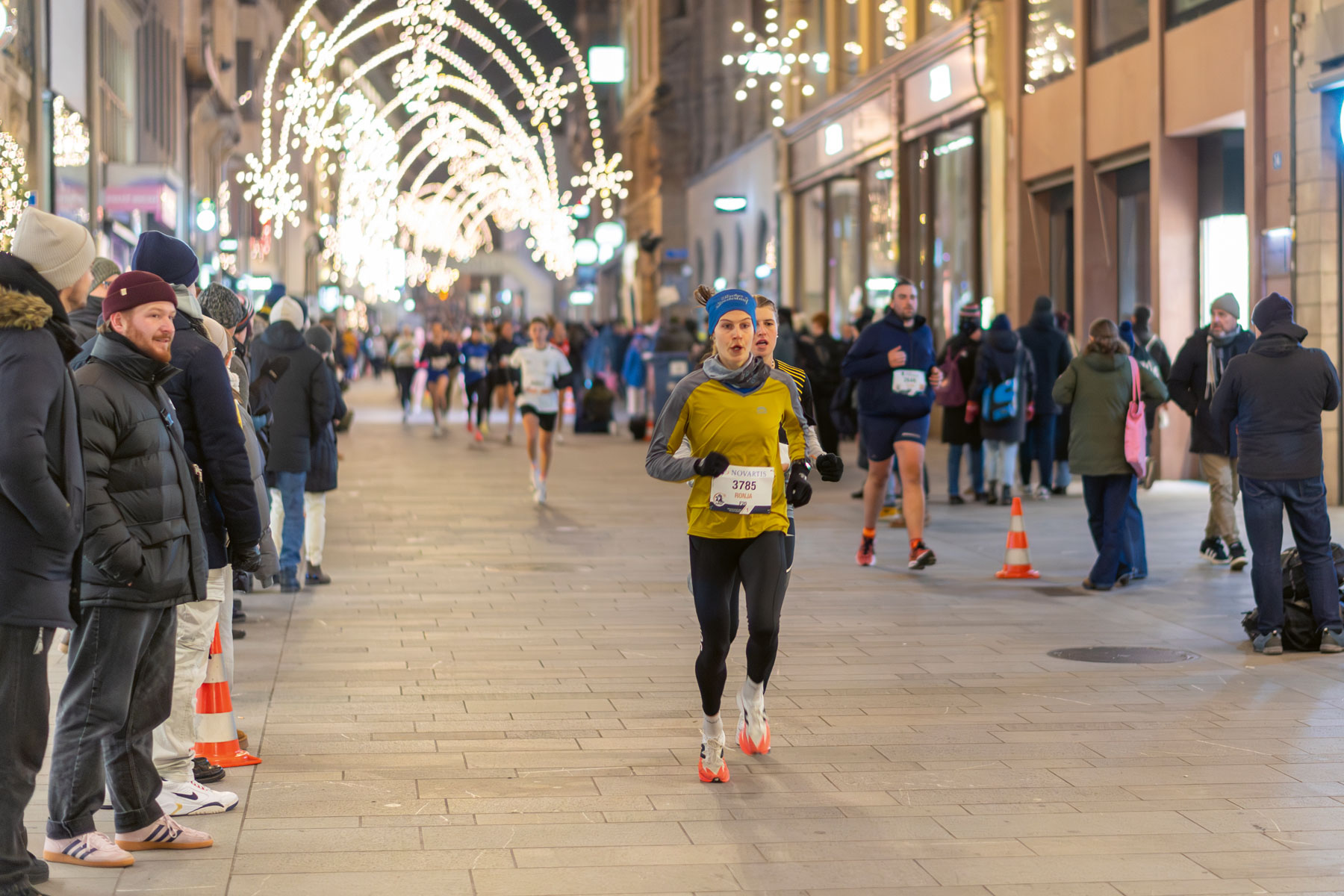
I use the 5.5 kilometres specifically as an intense speed workout, deliberately pushing myself into the lactate zone. That’s much easier at an event with such a strong tradition and atmosphere than when training alone. I find the atmosphere particularly impressive every time, especially running through the dark, illuminated streets and alleyways.
For part of the race, you were running alongside Shirley Lang from LC Therwil. What was your tactical approach to the race – and what did this city run give you mentally or emotionally that you don’t get from a marathon?
My race strategy is basically clear: all-in. If you don’t try, you can’t win. I tried to run my own race and consistently push myself to my limits.
Knowing that Shirley was right behind me gave me additional motivation not to ease off. Mentally, a city run is very different from a marathon: the atmosphere is much louder, and you’re hardly ever running alone. That gives you an incredible amount of energy and makes it great fun.
Alongside sport, you are studying and working part-time. How do you manage to balance everything in your daily life, and what motivates you to keep pursuing this path so consistently?
It’s definitely not always easy to juggle everything. At the same time, I receive a great deal of support from all sides, which is what makes this balancing act possible in the first place.
The joy of running, my genuine interest in my studies and the positive environment at work motivate me every day to keep pursuing this path consistently.
What fixed points or goals outside competitive sport help you maintain balance as an athlete?
The additional demands of studying and working remind me that there is more to life than training. That helps enormously in maintaining balance. If a training session doesn’t go optimally, it’s easier to put it into perspective and move on.
The dream of competing at the Olympic Games is a major goal that you speak about openly. How does that dream evolve with every race – and where do you currently see the decisive step towards achieving it?
I see every race as an individual piece of the puzzle on this journey. Of course, I hope for good results and fast times, but the experiences and lessons I can take into future races are just as important.
At the moment, a crucial step is focusing on shorter distances such as the 10 kilometres and half marathon, becoming faster there and later carrying that pace over to the marathon distance.
Finally, what advice would you give to young female runners who are just starting out – perhaps with the goal of one day winning a race like the Basler Stadtlauf? And based on your own experience of this race, what would you like to tell first-time participants in the Basler Stadtlauf as well as ambitious recreational runners from Basel?
Dream big – work hard. To achieve great things, you also have to be able to dream big. Having a clear goal provides motivation, especially on days when the joy of running isn’t immediately there. At the same time, enjoying running remains the most important thing – without passion, the effort can quickly become a burden.
I would advise first-time participants in the Basler Stadtlauf to run with plenty of joy and an open mind and to soak up the unique atmosphere. And for ambitious runners, perhaps a little provocatively: nothing ventured, nothing gained. So it’s better to go all-in – in the best-case scenario, you’ll achieve a great time; in the worst case, you’ll gain valuable experience.
Many thanks to Ronja Hofstetter for the interview.