


A Childhood Dream Comes True
You said that winning the Basler Stadtlauf was a childhood dream come true. What did that moment at the finish line mean to you – and why was this particular race so special?
I grew up in Rheinfelden, spent many years training on the track with LC Basel, and Basel is my hometown. The Basler Stadtlauf was one of the first races I ever took part in. Winning this race, which had already been one of the sporting highlights of my running year many years ago, means an incredible amount to me. Crossing the finish line in first place was the fulfilment of the dream I had as a little boy: to one day be among the fastest runners.
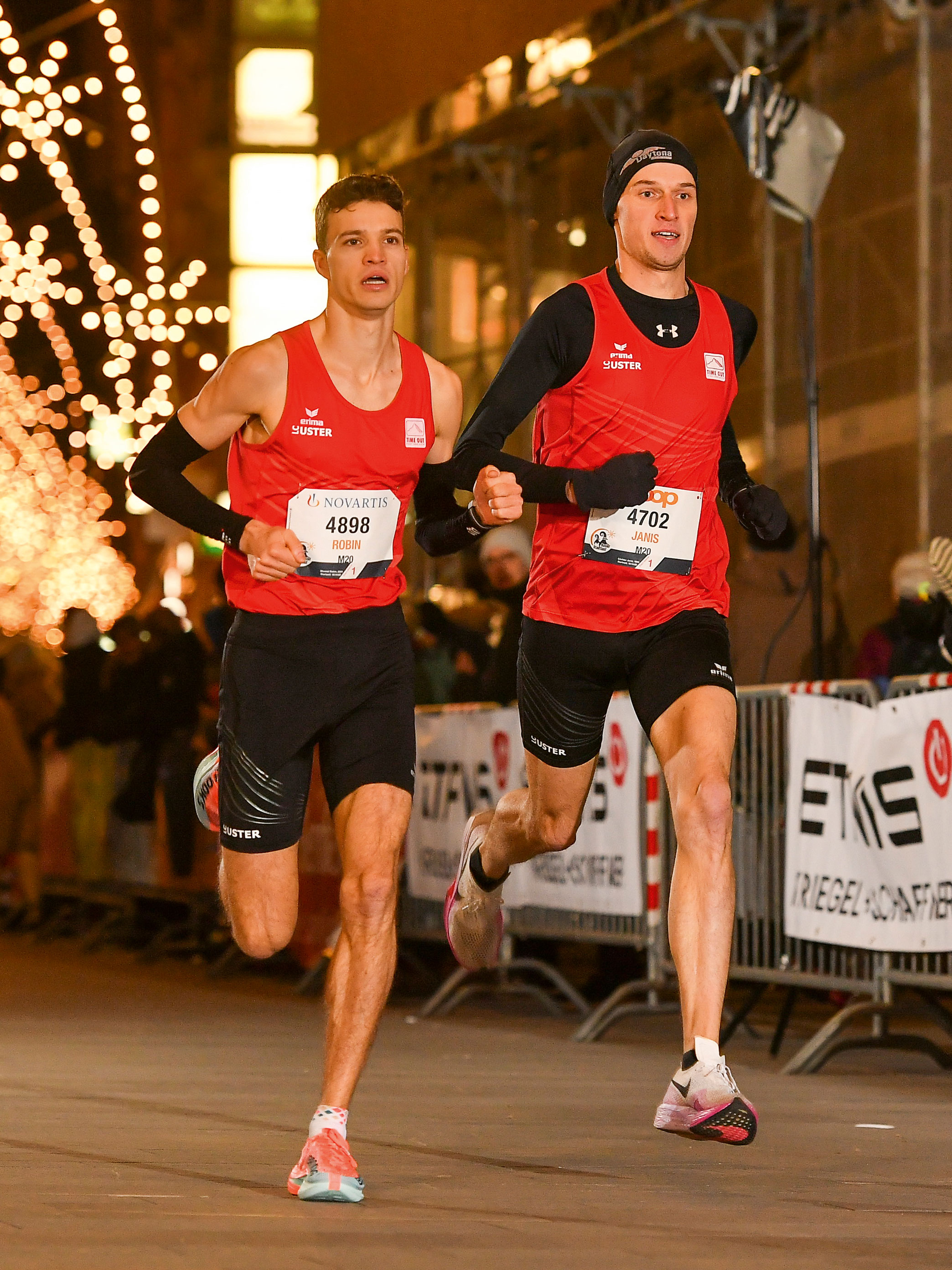
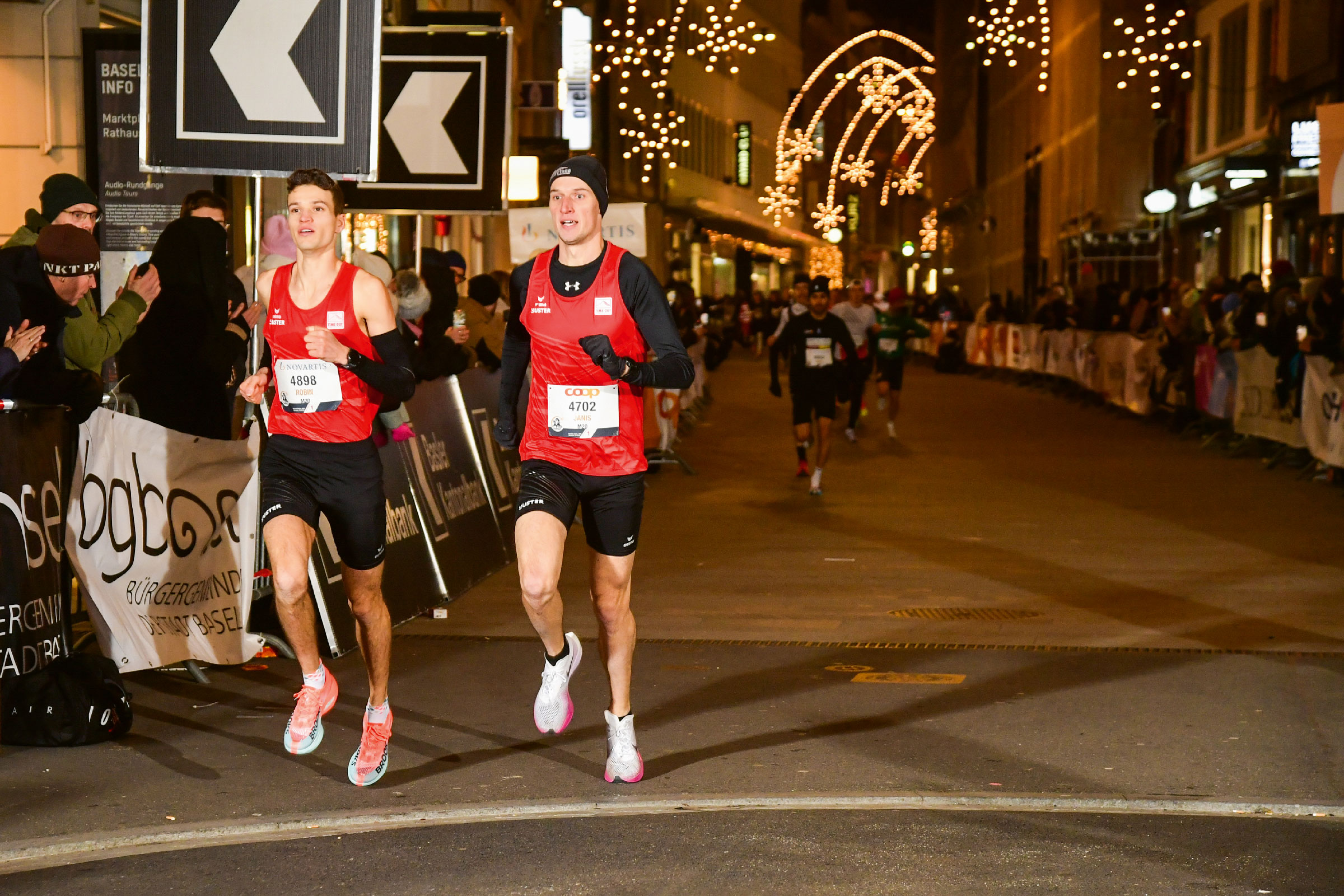
Robin Mennet (left) and his LC Uster teammate Janis Gächter lead the field through Freie Strasse. Mennet eventually celebrates his first victory at the Basler Stadtlauf.
What was your tactical approach to the Basler Stadtlauf – did you start cautiously or were you determined to set the pace early on? Was there a particular moment or section of the course when you realised that this could be your race?
I knew I was among the fastest runners on the starting line and wanted to take a very attacking approach to the race. At the same time, I was aware that starting too quickly could come back to haunt me later. I was therefore surprised that, by the time we turned into Freie Strasse for the first time, only two of us were left at the front. Apparently, nobody else had dared to match our pace. After three-quarters of a lap, my remaining rival Janis also had to let me go on the Wettstein Bridge. From that point on, the second lap was simply there to be enjoyed!
How did you experience the atmosphere along the course in Basel? Is there a particular section or moment that stands out in your memory – whether because of the spectators or the city's surroundings?
Of course, Freie Strasse has its own special magic during the Basler Stadtlauf. The gentle downhill slope gives you a feeling of weightlessness. The golden Christmas lights and the cheering crowds rushing past seem to merge into one, creating an exhilarating sensation that enchants me every single time. Experiencing this section of the course as the race leader is something truly special.
Your LC Uster teammate Janis Gächter also finished on the podium. What does this result say about the club's work and team spirit? And does having a teammate in the same race play more of a tactical or psychological role – or do you simply block that out during competition?
When I moved to the Zurich area for my studies, I had to make the difficult decision to leave LC Basel and join LC Uster. It wasn't easy, but it was the only logical step if I really wanted to continue developing as a runner. Today, I owe an enormous amount to LC Uster. I feel completely at home there and represent the club with great pride. LC Uster has helped many runners become faster and has an incredible depth of talented athletes. That's why it's so enjoyable to line up alongside teammates and dominate a race together. During the race itself, however, I'm very much an individual competitor. I usually have my own tactics and I want to win. That makes me appreciate warming up and cooling down together even more.
How important has LC Uster been to your development as an athlete, particularly in terms of the training environment, exchanging ideas and everyday motivation?
LC Basel transformed me from a young orienteering athlete into a fast regional runner. LC Uster then helped me progress to my first Swiss championship title. Success always comes from a combination of different factors. In my case, one of the most decisive was certainly meeting my current coach, Eric Rüttimann, who was himself an active elite runner at LC Uster at the time. He was the spark that ignited my passion for the sport. Since then, LC Uster has played an important role in my life as a team, providing the right environment and the support I need. However, I do most of my actual training alone and rarely attend track sessions in Uster. Of course, being part of a team with such a high standard motivates me to give my best every single day.
In 2025, you became Swiss half-marathon champion and set a personal best of 1:06:16 in the same year. What does winning a city race tell you about your current form, and how does the challenge of a city race differ from longer distances?
City races are often chaotic and very hectic. The atmosphere along the course is overwhelming, but the race itself is over all the more quickly. I really enjoy this type of competition, although I feel more comfortable over longer distances. In a half-marathon, you have more time to enjoy the race. In a city race, finding the right pace is more difficult because these races always start very fast, and the many corners don't make things any easier. You need patience and confidence in your instincts and the race strategy you've worked out beforehand. My form was very good last autumn. However, as became clear over the following winter, it was nowhere near as good as it would become a few months later.
From your perspective as an athlete, in which areas could the Basler Stadtlauf develop further to better accommodate competitive runners without losing its character as a popular public event?
In my opinion, the main problem for faster runners at the Basler Stadtlauf is that you have to overtake a large number of other participants on the second lap. I found it difficult to make my way through the crowds, and on the finishing straight I doubt the spectators even noticed the leading runners. Finishing sprints and battles for position were lost among the many participants. In my personal experience, the instruction to keep right and overtake on the left didn't work particularly well this year. I think it might make sense to group runners according to their expected finishing times rather than age categories, as is already done at other popular races such as the GP Bern. This would largely eliminate the problem of lapping other runners and create more space for genuine racing on the final lap. Of course, such a change would mainly benefit the leading runners. However, I could also imagine that it would make the race more enjoyable for participants further back in the field, as they would no longer have to keep looking over their shoulders to make way for faster runners coming through.
Looking ahead, which sporting goals and areas of development are particularly important to you? And where would you like your journey as an athlete to take you in the long term, regardless of specific times or titles?
My main goal is always to enjoy running. That is the most valuable thing in this sport. It's what connects us all and something we should all share. Given my preference for longer distances, I will probably give in to the temptation next autumn and make my marathon debut. What happens after that remains to be seen. But I will certainly always enjoy returning to Basel to experience these streets and the unique atmosphere together with all the participants in the Basler Stadtlauf.
Many thanks to Robin Mennet for the interview.


